

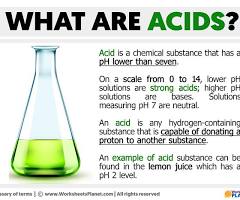
In chemistry, an acid is a substance that increases the concentration of hydrogen ions (𝐻+) when dissolved in water, typically has a sour taste, and a pH less than 7. Acids can also be defined more broadly as a proton (hydrogen ion) donor or an electron-pair acceptor.
Key Chemical Definitions
The concept of an acid has evolved through several key theories:
- Arrhenius Acid: A substance that, when added to water, increases the concentration of hydronium ions (
𝐻3𝑂+).
- Brønsted–Lowry Acid: A more general definition, where an acid is any molecule or ion that can donate a proton (
𝐻+) to another substance (a base). This is the most widely used definition in general chemistry.
- Lewis Acid: The broadest definition, where an acid is a species that can form a covalent bond by accepting an electron pair.
Common Properties
Acids exhibit several characteristic physical and chemical properties:
| Characteristic | Property |
|---|---|
| Taste | Sour (e.g., lemons, vinegar). (Warning: Never taste unknown chemicals). |
| pH Level | Below 7 on the pH scale (7 is neutral; lower pH means higher acidity). |
| Litmus Test | Turns blue litmus paper red. |
| Reactivity | Reacts with bases to form salt and water in a neutralization reaction. Many strong acids are corrosive and can react with metals to produce hydrogen gas. |
| Conductivity | Conducts electricity in an aqueous solution due to the presence of free ions. |
Everyday Examples of Acids
Acids are found everywhere, from nature to industry:
- Acetic acid: Found in vinegar.
- Citric acid: Found in citrus fruits like lemons and oranges.
- Hydrochloric acid: The primary component of gastric acid in your stomach that aids digestion.
- Sulfuric acid: A strong, highly corrosive acid used in car batteries and industrial processes.
- Carbonic acid: An aqueous solution of carbon dioxide and water, found in carbonated drinks.
Acids can be categorized as strong (like hydrochloric acid, which completely dissociates in water) or weak (like acetic acid, which only partially dissociates).