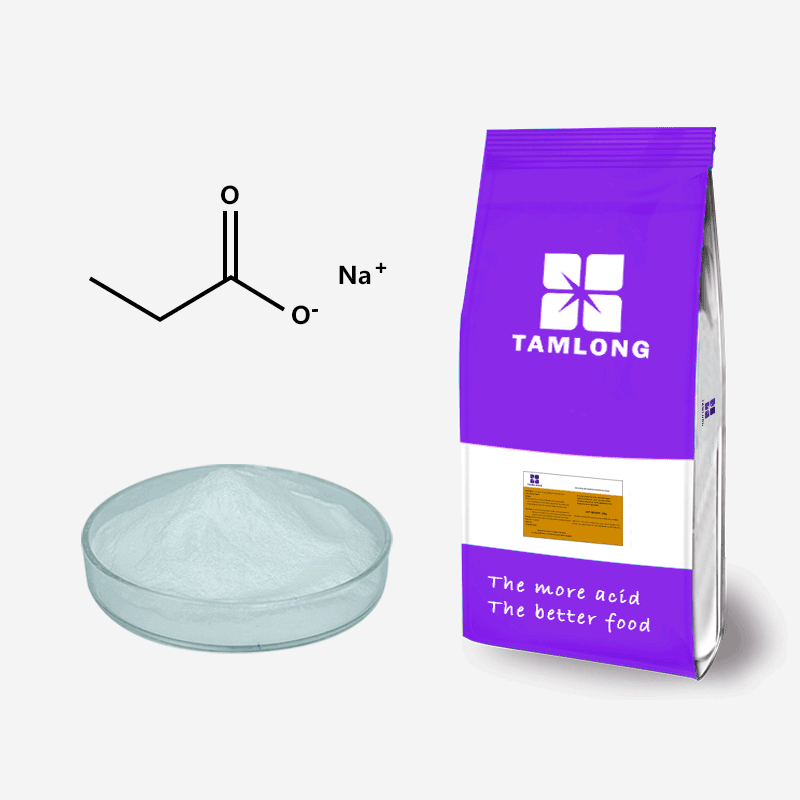
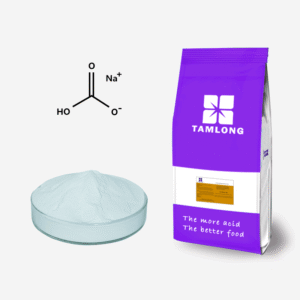
| Sodium Propionate Product Quality Indicators |
| Analysis Items |
Specification |
| National Standard (GB 25549 – 2010) |
Food Chemicals Codex (FCC V) |
| Content (%) |
≥99.4 (dry basis) |
≥99.4 (anhydrous basis) |
| Propionic Acid (%) |
76 |
76 |
| pH Value (10% Solution) |
7.0 – 10.0 |
7.0 – 10.5 |
| Free Acetic Acid (ml/g) |
Pass the Test |
Pass the Test |
| Free Alkali (ml/g) |
Pass the Test |
Pass the Test |
| Alkalinity (%) |
0.15 |
0.15 |
| Fe(Fe)ppm |
≤15 |
≤15 |
| Heavy Metals (Pb, ppm) |
≤4 |
≤4 |
Application Scope
1. Antiseptic Characteristics: The antibacterial effect is affected by pH (the minimum inhibitory concentration is 0.01% at pH5.0 and 0.5% at pH6.5). It has a strong inhibitory effect on molds, aerobic spore – forming bacilli, and gram – negative bacilli, can prevent aflatoxin, and has no effect on yeasts.
2. Leather – making Application: As a masking agent to improve the alkali resistance and tanning uniformity of leather.
3. Food Preservation: Used in pastries (addition amount ≤2.5g/kg), bayberry soaking liquid (maximum 50g/kg) to extend the shelf – life.
4. Feed Anti – mildew: The general addition amount is 0.1 – 0.3% to inhibit feed mildew.
5. Cosmetic Use: Preservative (addition amount ≤2%), broad – spectrum antibacterial against molds and yeasts, and more effective under acidic conditions.
Food – grade Sodium Propionate, Industrial – grade Sodium Propionate, Feed – grade Sodium Propionate